The censorship workaround.
What happens when civil-society tools are removed from app stores under government pressure? AntiFreeze is a case study in architectural resistance.

Real-time, anonymous ICE sighting alerts that can't be pulled from any app store.
In October 2025, the Trump administration pressured Apple and Google to remove every ICE-tracking app from their stores. ICEBlock, the most-used app in the category, was pulled overnight. The communities that relied on those tools lost them in a single news cycle.
AntiFreeze was built to survive exactly that scenario. It's a Progressive Web App — a website that installs to your phone's home screen and behaves like a native app, including push notifications. There is no app store gatekeeper. There is no corporate intermediary that can be pressured into removing it.
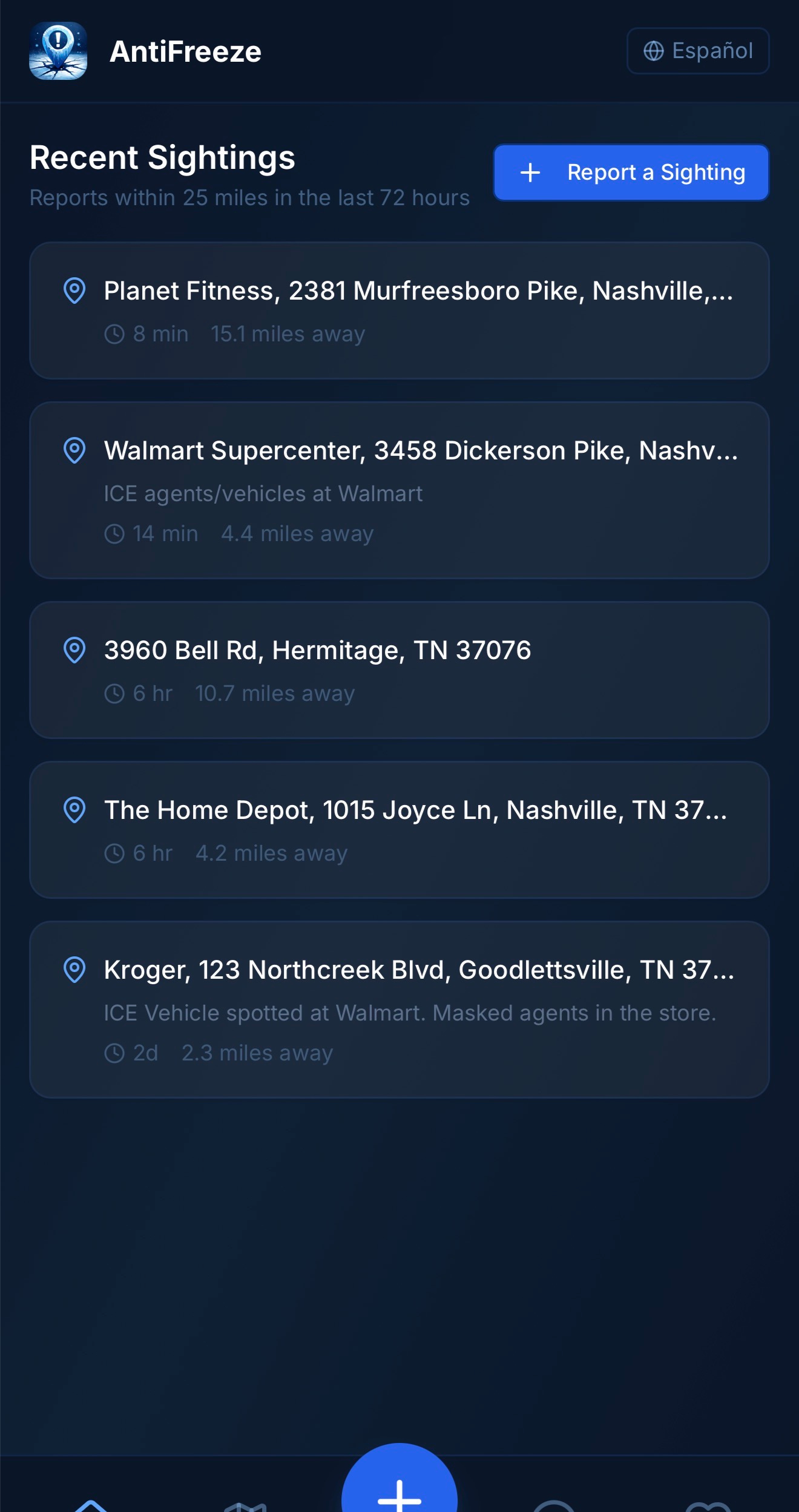
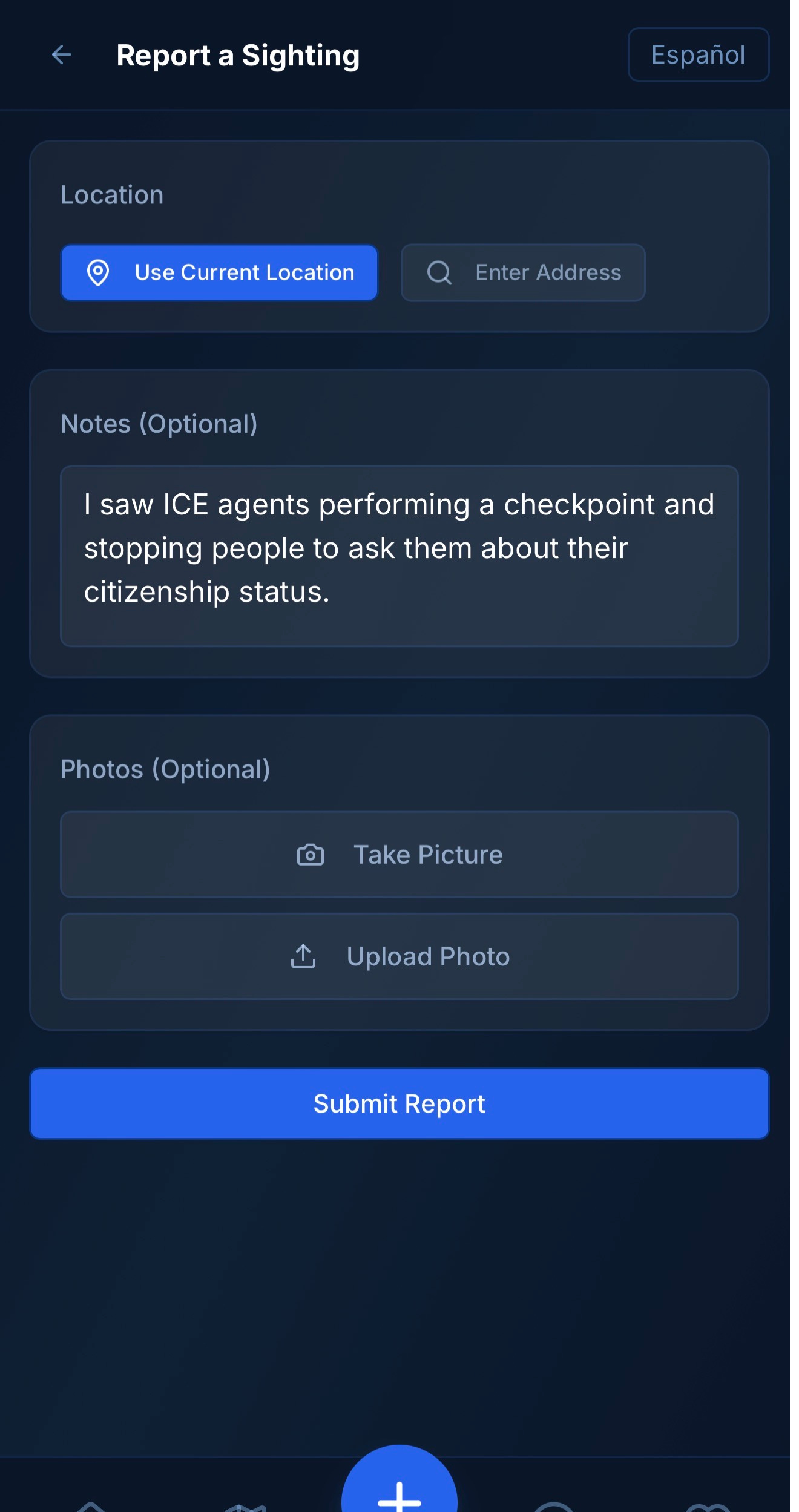
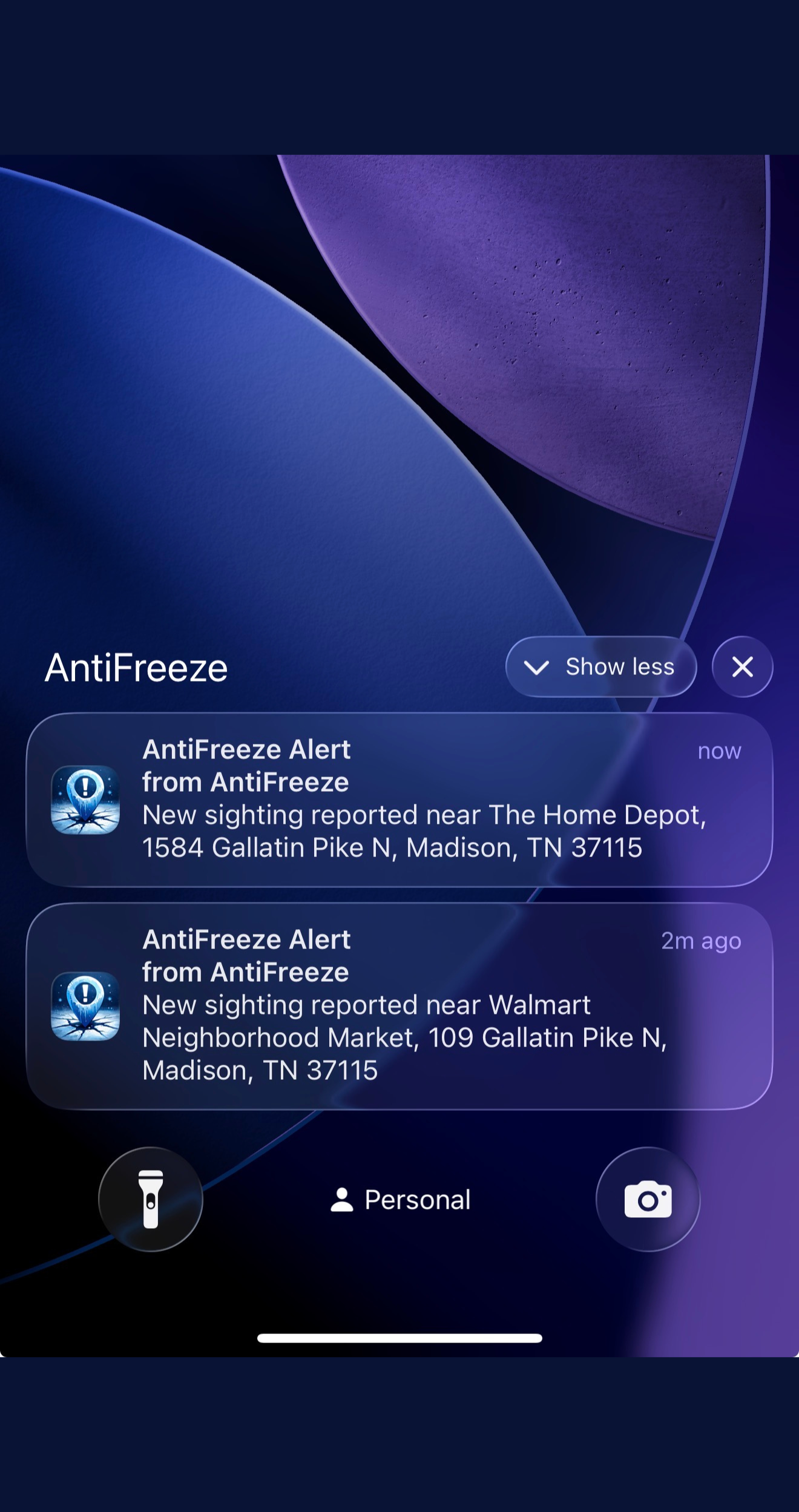
A user sees ICE activity, opens the app, taps "Report." Their GPS location is captured, the report is anonymized, and within seconds, every AntiFreeze user within 5 miles gets a push notification. Users can also browse a live map of nearby sightings — or open the full nationwide feed with a tap.
All quotes can be attributed to Josh, the solo developer behind AntiFreeze. Josh prefers to be referred to by first name only in coverage.
"ICEBlock didn't fail because the technology was bad. It failed because it had a single point of failure: the App Store. AntiFreeze was built so that the same phone call that killed ICEBlock can't kill this. It runs on the open web. There's no gatekeeper to pressure."
"If ICE is spotted four blocks from your house while you're making dinner, your phone should buzz and tell you. That's it. That's the whole idea. People deserve to know what's happening in their own neighborhoods, and they deserve a tool to share that with each other that nobody can take away."
"I'm one person. I don't have a company behind me, I don't take money for this, and I don't run ads. I built it because the tools communities were relying on had a single point of failure, and that failure happened exactly the way everyone should have expected it to."
"There's no sign-up, no email, no phone number, no account. We use an anonymous device ID and that's it. We don't know who our users are, and we never will. That's not a marketing claim — it's the architecture. There's nothing to hand over because we never collected it."
A current list lives at antifreeze.app/press.
What happens when civil-society tools are removed from app stores under government pressure? AntiFreeze is a case study in architectural resistance.
How communities are using mutual-alert technology to protect each other in a moment of escalated enforcement.
One person, no funding, no team, building infrastructure that thousands of people rely on. Why this kind of project keeps emerging in moments of institutional failure.
AntiFreeze collects no personal data at all. It's a working counterexample to the assumption that useful apps require user data.
AntiFreeze and stopice.net trade sightings in both directions rather than fragmenting the same community across rival apps — an unusual answer to a problem where a missed alert is the cost of a walled garden.
AntiFreeze launched with full English and Spanish support — built in from the start to serve the communities most directly affected by ICE enforcement, not retrofitted later.
AntiFreeze is built and maintained by Josh, a U.S.-based solo developer who works on the project independently and as a hobby. Josh prefers to be referred to by first name only in coverage. Available for interviews via email, Signal, and Bluesky.